Winners
Asia
The Courageous Scientists Award is meant to honour and draw attention to researchers dedicated to protecting the earth and its inhabitants even under great personal risk. In the case of Asia, we offered the award to two different researchers from two different countries; while both were appreciative, they declined the prize because there was a good chance that the attention the prize could draw would put them, their work and the greater cause in danger. It is a stark reminder that researching the pressing problems of our times is not without danger.
Olanrewaju Suraju – Africa, Nigeria
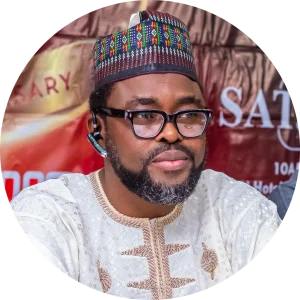
Olanrewaju Suraju is a prominent Nigerian human rights and environmental activist, known for his courageous work in anti-corruption, climate justice, and civic accountability. As Chairman of HEDA Resource Centre, he leads campaigns that expose environmental degradation, illicit financial flows, and governance failures across West Africa. He has played a key role in advocating for transparency in extractive industries and pushing for climate-resilient policies that protect vulnerable communities.
For Olanrewaju ‘’courage in science means standing up for and defending evidence-based truth when it is unpopular or faces resistance or attack from powerful interests. It requires questioning established norms, advocating for ethical interrogation, and persistence in the pursuit of a cause in the face of vicissitude and personal risk.’’ He is no stranger to exhibiting courage having faced threats and legal intimidation for his outspoken stance against corruption and environmental injustice, notably in high-profile cases involving multinational corporations and government actors. Despite these challenges, he continues to mobilize civil society, engage international institutions, and empower grassroots movements to demand accountability and sustainability.
Dr. Elisa Privitera – Europe, Italy
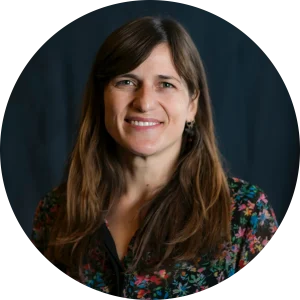
Elisa (Lizzy) Privitera engages with ‘’climate and environmental crises through a critical, intersectional lens, while also grounding that perspective in real-world problems and collaborative efforts to envision just, actionable solutions.’’ Her doctoral work focused on the city of Gela in her native Sicily, a town grappling with the aftermath of a decommissioned petrochemical plant. Lizzy worked with residents to map the effects of pollution, trigger conversations around new possibilities and develop recommendations to reverse unjust trajectories of development. Just like the anti-Mafia activists who have inspired her, Lizzy does not shy away from speaking out about the role of the Mafia in controlling water and coastal areas of dumping toxic waste, despite the risks.
Currently Lizzy is a post-doctoral researcher at the Urban Just Transitions cluster at the University of Toronto Scarborough, co-leading the Listening Project, a community-based research initiative that aims to work with community partners to understand and envision equitable transitions. Specifically she is looking to understand how climate policy aimed at achieving net-zero aligns with the daily concerns and aspirations of residents in Scarborough, a diverse working class borough on the edge of Toronto. She strongly believes that courageous scientists not only generate knowledge to support fair socio-technological transitions, but to also repair past harms and to heal wounded relationships.
Dr. Rose Abramoff, North America, United States
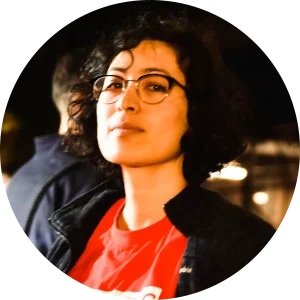
Professor Rose Abramoff is a professor of forest science at the University of Maine in the northeastern United States. Her research focuses on how climate change and human land use affect the land carbon cycle, particularly below ground components like plant roots and soil: she combines field and laboratory measurements with modelling.
Rose dedicated herself to climate-related research because she wanted to contribute to solving the global problem of our times by ”discovering truths and communicating them to policymakers, who would listen carefully to me and take appropriate action”. When she realized that despite the mounting evidence and warnings from scientists like herself, governments were not acting, she decided to chain herself to the White House fence with other scientists during the Scientist Day of Rebellion in 2022, demanding that President Biden declare a climate emergency. Her inspiration for participating in civil disobedience was climate scientist and former Director of the NASA Goddard Institute for Space Studies, James Hansen, who had chained himself to the very same fence back in 2013 to protest mountaintop removal mining and expansion of a crude oil pipeline.
Since then she has participated a number of civil disobedience actions; at the American Geophysical Union annual meeting in December 2022, an association of 60,000 earth and space scientists, Rose and her fellow scientist Peter Kalmus jumped onto a stage and unfurled a banner with the message, “Out of the lab & into the streets” just before the speakers joined the stage. Her employer at the time, the Oakridge National Laboratory fired her. Rose continues to push scientific institutions to support activism and advocacy, especially by experts and to help scientists acknowledge and address their emotions around the climate crisis in order to turn grief and fear into hope.
Olivia Bisa Tirko – South America, Chapra Nation, Peru
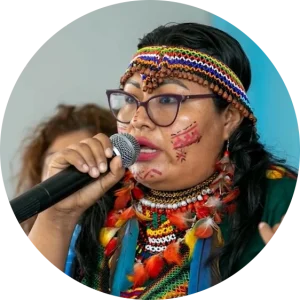
Olivia Bisa Tirko is the Indigenous leader and first female president of the Autonomous Territorial Government of the Chapra Nation in Datem del Marañón Province, Loreto, Peru. Since assuming leadership in mid-2022, she has recentred the role of women in the Peruvian Amazon in addressing social and cultural issues and as keepers of ancestral knowledge. She sees the science of her people as ”a living science that teaches how to sustain life, not how to dominate it,” which is reflected in her efforts to protect the environment and future generations from the colonial disruption of their cultural practices.
Olivia has demanded remediation for oil spills, which have contaminated water sources that sustained fishing livelihoods and food supplies for her community. She has also successfully stopped the state-owned Petroperu from attracting financing from international banks to expand an oil field during their most recent bid attempt in May of this year, working closely with
other Indigenous leaders and international campaigners.
For Olivia, ”courage in science is the ability to uphold truth and knowledge in the face of fear, violence, and imposition. It is having the strength to continue observing, researching, speaking, and acting, even when doing so puts one’s life at risk.” She has been included on national lists of Indigenous defenders under serious threat, with the safety of her and her two young children in grave jeopardy.
Cynthia Houniuhi – Pacific, Pacific Islands
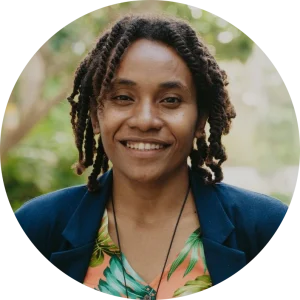
Cynthia Houniuhi, an Indigenous lawyer and lecturer from the Solomon Islands, thought big with 26 of her fellow law students at the University of the South Pacific back in 2019 – they created the Pacific Islands Students Fighting Climate Change (PISFCC) in order to seek an advisory opinion from the International Court of Justice (ICJ) on the obligations of states regarding climate change, including from a human rights perspective. As she wrote us, ”courage means choosing to pursue a pathway that you believe can add to your cause even when all the odds are against you!”
Lecturer Justin Rose, whose course had motivated the students to take on climate justice from a legal perspective, was able to convince the small island state of Vanuatu to be an official state sponsor. There after Cynthia and her fellow students attended international climate meetings with activists from around the globe to lobby states their efforts. It paid off – 132 countries agreed to co-sponsor a resolution before the UN General Assembly, calling on the ICJ to provide its opinion on two key questions: what obligations do states have to tackle climate change under international law and what are the legal consequences if they fail to do so?
In November 2024 Cynthia spoke at the ICJ’s public hearing in November 2024, telling the court how her people’s land of Fanalei was disappearing due to rising seas. “Without our land, our bodies and memories are severed from the fundamental relationships that define who we are,” she said. In July 2025 the ICJ made a historic ruling, deciding that those suffering the impacts of the climate crisis have the right to sue and demand compensation.